
How to Compare Two Mining Pool Fee Schedules Fairly
Two fee schedules can only be compared after both are converted into the same unit, and the useful unit is dollars per PH/s per month. At 1 PH/s the gross block-reward income is 0.014206 BTC a month, about $1,211.68, so a 4% charge on that component is $48.47 and a 2% charge on the same component is $24.23. The gap between the two schedules is $24.23 a month, which is exactly the size of the second layer.

Key takeaways
- Normalise both schedules to USD per PH/s per month before comparing them. One PH/s earns $1,211.68 of block-reward income a month at current difficulty.
- Check which component each rate touches: a percentage attached to the block reward is not the same as one attached to transaction fees.
- Match the payout cadence. PPS+ settles every hour at current difficulty, while PPLNS pays after 6 confirmations across the last 5 difficulty rounds.
- Run the same period, the same hashrate and the same price for both schedules. Anything else is a comparison of two different things.
Convert both schedules to dollars
Percentages hide scale, so the first move is to multiply each rate by the income it charges. A TH/s produces 0.0000004735 BTC a day at a network difficulty of 132.76 T, which is about $0.0404 at a BTC price of $85,294. Scale that to 1 PH/s and the month is 0.014206 BTC, or $1,211.68. Now the schedule becomes concrete: $48.47 a month on the block-reward component under the four-percent rate, $24.23 under the two-percent rate, and the second figure is the entire advantage one schedule can hold over the other at this hashrate.
Ten times the hashrate multiplies both numbers by ten. At 10 PH/s the same schedules charge $484.67 and $242.34 a month, and the gap becomes $242.33 — real money that has nothing to do with luck, hardware or electricity. That is why the comparison has to happen on paper before a contract is signed.
Watch the asymmetry in how the rates are applied. The published schedule attaches 4% to the PPS-settled block reward and 2% to the transaction-fee component under PPS+, then charges 2% across both components under PPLNS. A miner comparing "4% versus 2%" is not comparing the same base; one number lands on a large, steady component and the other on a component that swings block by block.
Five things to hold constant
A fair comparison fixes inputs and lets the fee vary. Fix the hashrate, because percentage-only reasoning collapses at small scale: at 100 TH/s the block-reward income is $4.04 a day, so the four-percent rate costs about $0.16 a day, or $4.85 over a month, and at that size an extra half-cent on power matters more than the whole fee difference. Fix the window, because a 30-day window and a 26-day window produce numbers 15% apart. Fix the difficulty basis, since every adjustment moves income for both schedules at once.
Then fix the two treatment rules that get skipped. First, transaction fees: if one estimate folds them into the block reward and the other reports them separately, the percentages are being applied to different totals. Second, the payout date: an hourly PPS+ credit and a PPLNS payout that waits for 6 confirmations across the last 5 difficulty rounds both land in your account, but they sit on different days, and comparing a 30-day figure from one against a 30-day figure from the other is only correct if you account for the confirmation lag at both ends.
| Variable to fix | The figure to hold | Why it changes the answer |
|---|---|---|
| Hashrate basis | 1 PH/s = 0.014206 BTC a month = $1,211.68 | At 100 TH/s the same percentages are worth $4.85 a month, so scale changes the conclusion |
| Time window | 30 days, or 720 hours at 1 PH/s | A 26-day window understates a monthly charge by about 13% |
| Difficulty | 132.76 T, with a 1.90% increase estimated | Both schedules move with difficulty, so the ratio holds but the dollars do not |
| Transaction fees | Reported separately from the block reward | The 2% component attaches to transaction fees, which vary block by block |
| Payout timing | PPS+ hourly against PPLNS after 6 confirmations | A lag moves income between months even when annual totals match |
| PPS+ block reward | 96% of the listed component reaches the miner | This is the row where the 4% actually lands |
Worked example: one month, two schedules
Take 1 PH/s for 30 days and run both schedules line by line. Gross block-reward income is 0.014206 BTC, which is $1,211.68 at $85,294. Under the four-percent rate on the PPS-settled block reward, the charge is $48.47, so $1,163.21 lands. Under the two-percent combined rate, the charge is $24.23, so $1,187.45 lands. The difference is $24.24 with rounding, and it arrives whether or not the pool had a good month.
Scale the same month to 10 PH/s and the two schedules charge $484.67 against $242.34, leaving $11,632.13 and $11,874.46. Same ratios, ten times the money. Now add the luck dimension: the four-percent schedule removes pool luck and orphan risk from the miner's income, and the two-percent schedule leaves both in place. A comparison that lists only the rates is comparing a hedged product with an unhedged one, so write the payout method next to the rate in every line of your own table.
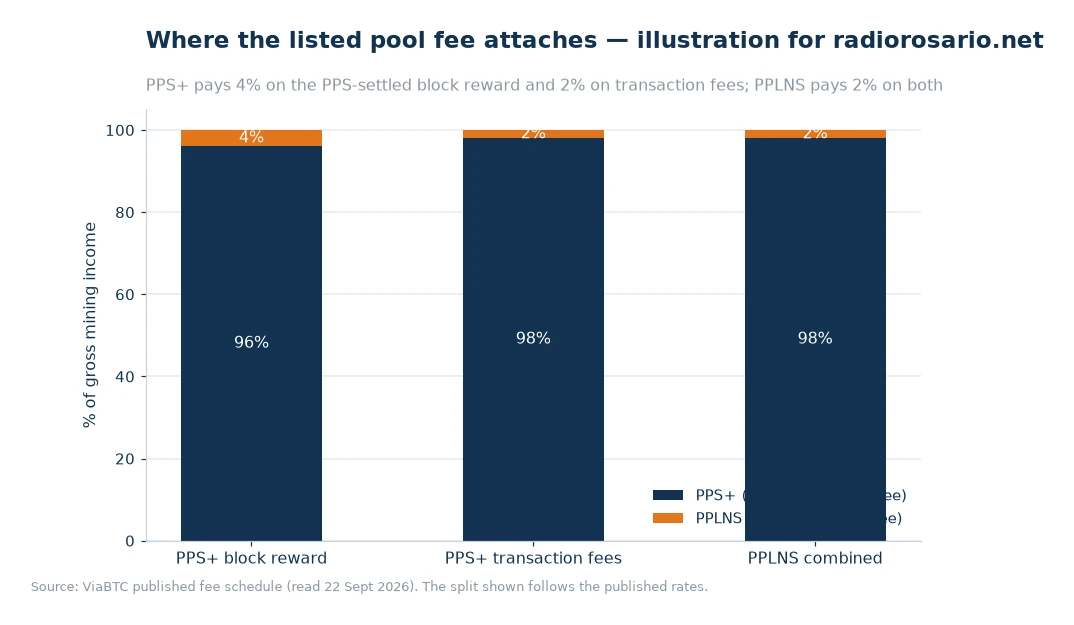
Two readings follow from the chart. The 4% row is the one that decides most miners' numbers, because the block reward is the bulk of income at current difficulty and transaction fees are excluded from the projection. The two 98% rows are identical in size even though they are charged under different payout logics, one on a component and one on the whole. Build the estimate on the components, never on a blended total.
Put a number on the small-fleet case
Small operators often shop on percentage alone and then discover that scale, not the rate, was the deciding variable. At 10 TH/s the daily block-reward income is $0.40, so the four-percent rate costs roughly $0.02 a day, about $0.49 across a month. At 300 TH/s the same rate costs $0.48 a day, or $14.54 a month, and at 1,000 TH/s it costs $1.62 a day, about $48.47 a month. Identical percentages, three orders of magnitude of difference in dollars.
Run both schedules through a single tool rather than two tabs. A Profit Calculator that accepts price, difficulty, hashrate and a fee rate lets you hold every input fixed and change one thing, which is the definition of a fair comparison. Then confirm the pool's live output against pool statistics so the projected hashrate is the one that is actually hashing. The published schedule itself, including the component-by-component breakdown of the ViaBTC Pool Fees, is the reference that both sides of the comparison should be read against.
Frequently asked questions
Is a 4% fee always worse than a 2% fee?
Not on its own terms. The 4% applies to the PPS-settled block reward, the steadiest component of income, and it removes pool luck and orphan-block risk from your result. The 2% applies across both components under PPLNS, where variance stays with the miner. Compare them as different products, not as two prices for the same thing.
What is the fairest single number for comparing schedules?
Dollars of fee per PH/s per month. At 1 PH/s the two component rates give $48.47 and $24.23 for a 30-day window, and either figure can be scaled linearly to any hashrate, which no percentage can do on its own.
Does the payout method change the fee comparison?
It changes the timing and the risk, not the listed rate. Hourly settlement under PPS+ and payment after 6 confirmations across the last 5 difficulty rounds under PPLNS both deliver the same schedule, on different days and with different variability attached.
Write the comparison once and reuse it
Set up a single sheet with hashrate, window, difficulty, price, both fee rates and both payout methods, and re-run it whenever difficulty moves — the current estimate is a 1.90% increase, which cuts gross income at the same power cost. The sheet should produce two landing figures per schedule, one before power and one after, because a fee advantage that is smaller than your electricity variance is not an advantage worth switching for. Keep the assumptions on the page next to the totals, and any provider's schedule can be dropped into the same frame without renegotiating the arithmetic.
Data and sources: ViaBTC listed fee schedule[1] and settlement rules as published[2]. Network difficulty (132.76 T), implied network hashrate (950.3 EH/s), the 1.90% next-adjustment estimate and the BTC price of $85,294 were read 22 Sept 2026. Figures are arithmetic on those inputs and change with difficulty and price; they are not a promise of earnings.