
Library Scent or Custom Build? A Gift and Travel Set Buyer's Checklist
Equipo de Redacción · Radio Rosario ·
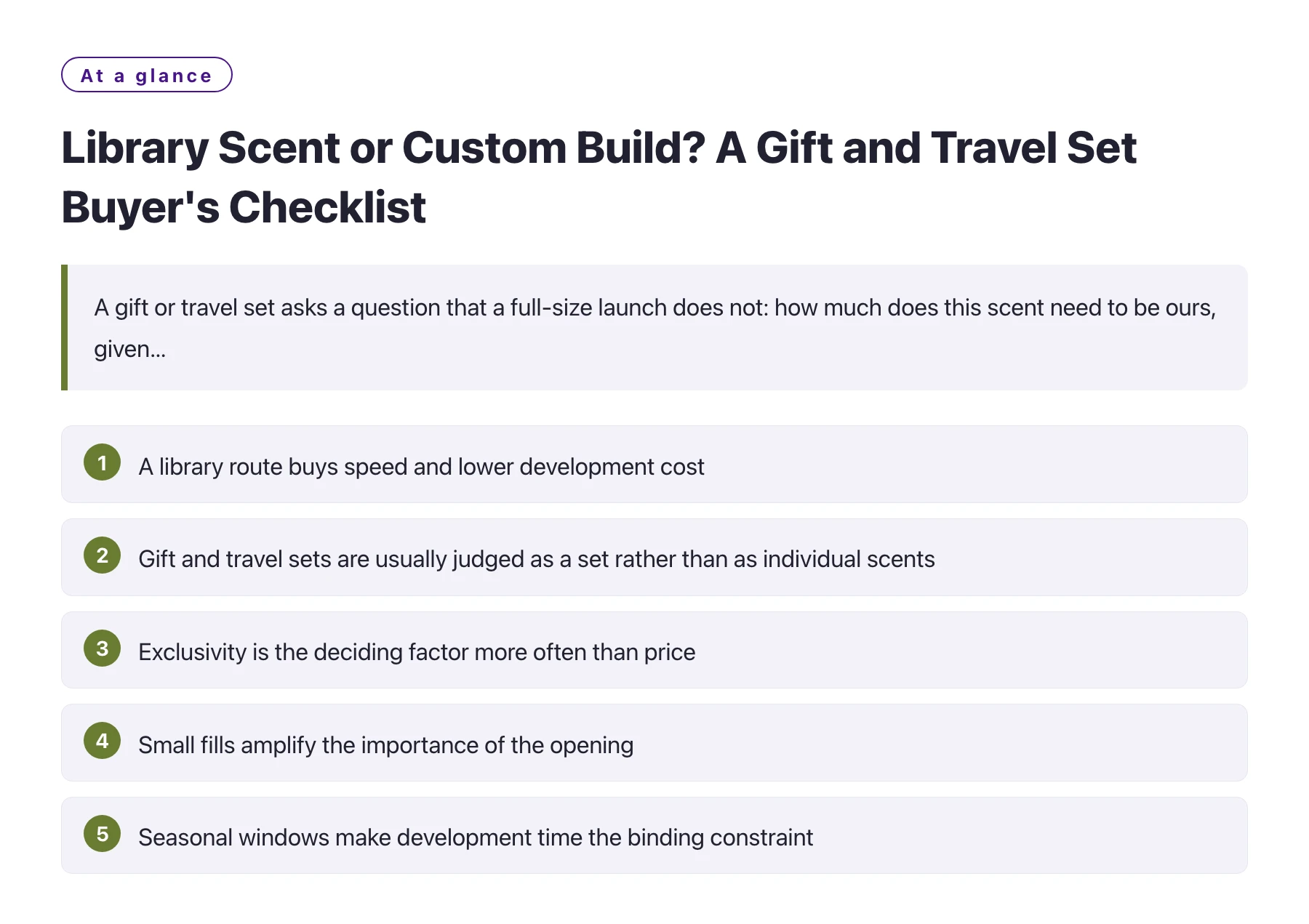
A gift or travel set asks a question that a full-size launch does not: how much does this scent need to be ours, given that each unit holds a few millilitres and the programme may run for a single season? The answer usually sits between two routes — selecting from a manufacturer's existing scent library, or commissioning development. Neither is better in the abstract. They differ in cost, time, exclusivity and risk, and the right choice follows from how long the product will live and how much of the brand promise rests on the scent.
Key takeaways
- A library route buys speed and lower development cost; a custom route buys distinctiveness and control.
- Gift and travel sets are usually judged as a set rather than as individual scents, which changes what has to be distinctive.
- Exclusivity is the deciding factor more often than price, because a library scent may be available to other brands.
- Small fills amplify the importance of the opening, since the buyer meets the scent in the first minutes of use.
- Seasonal windows make development time the binding constraint, so the calendar should be checked before the route is chosen.
- The route can differ within one set: a lead scent developed, supporting scents selected from a library.
Gift and travel sets have become a significant part of many fragrance programmes because they lower the entry price for a buyer and let a brand present a range rather than a single product. They also compress every decision. The fill is small, the quantity is often modest, the packaging carries most of the perceived value, and the selling window may be only a few weeks.
That combination makes the library-versus-custom question unusually consequential, and unusually easy to answer badly by defaulting to whichever option the manufacturer mentions first.
Why a gift or travel set changes the calculation
In a full-size launch, the scent is the product and the brand's investment in it is expected to be substantial. In a set, the scent is one element of an object that is bought, given and often used within weeks. The economics of developing three exclusive fragrances for a set that sells for a season rarely work, which is why selection and development are often mixed.
The exception is a set that carries the brand's signature scent, or one that is intended to be repeated annually. In those cases the scent is the asset, and treating it as a library pick usually turns out to be a false economy.
Small fills change what the buyer notices
A travel format is typically reapplied more often and evaluated faster than a full bottle. What registers is the opening and the first hour, not the depth of a dry-down that the buyer may never reach. That shifts the technical brief toward materials that perform immediately, and it is a consideration whichever route is chosen.
The set is judged as a composition
Buyers experience a set as a small collection, and the interesting question becomes whether the scents contrast with one another. A library can often provide that contrast quickly because the range is already organised; a custom programme needs the contrast written into the brief from the start.
Library route and custom route, dimension by dimension
| Dimension | Library route | Custom route | What usually suits a gift or travel set |
|---|---|---|---|
| Time to first sample | Days, because the compound already exists | Weeks, depending on rounds and revision | Short seasonal windows favour the library |
| Development cost | Usually limited to selection and testing | Perfumer time, sample rounds and evaluation | Modest quantities rarely justify full development across a whole set |
| Distinctiveness | The scent may also be offered to other brands | The compound can be reserved to the brand | The lead scent of a set is where distinctiveness earns its cost |
| Reformulation risk | Lower, because the compound has been in production | Higher, because the formula is new | Consider the selling window and whether a reformulation could land mid-season |
| Exclusivity | Typically limited or unavailable | Negotiable by term, territory and product | Depends on whether the set is a one-off or an annual fixture |
| Component fit | Precedent available from previous fills | Compatibility work required for the chosen format | Travel formats with unusual closures benefit from precedent |
The fourth column is where a product developer earns their place. The route is rarely decided for the whole set. A common and sensible structure is one developed scent that anchors the collection and two selected scents that support it, which keeps the distinctiveness where it is noticed and the cost where it can be absorbed.
A checklist to run before choosing the route
- Fix the selling window firstWrite down the date the goods must be at the retailer and work backwards. If the development rounds cannot fit, the route has already been decided.
- Decide what the scent has to proveIs the scent the brand's signature, or one element of a giftable object? Only the first case justifies development across the whole set.
- Ask what exclusivity means in writingTerm, territory and whether the compound may be offered to other brands in other categories. Verbal assurances are not useful here.
- Price the whole set, not the scentComponents, decoration, the presentation box and assembly usually dominate the unit cost of a set. Compare routes on total cost.
- Check component and format constraintsTravel sprays, minis and roll-ons have their own fill and compatibility limits. Confirm that the intended format works with the chosen compound.
- Plan the second season before the first shipsIf the set will be repeated, an annual library pick becomes a fingerprint. Decide early whether the anchor scent should be developed and owned.
Where the two routes are sourced from the same place
The library-versus-custom decision is often framed as a choice between two kinds of supplier. In practice, a partner that operates as an ODM fragrance manufacturer usually offers both: a range of existing compounds to select from and a development service for briefs that need something new. That is convenient, and it also means the conversation should include a direct question about which compounds are already in production and for whom.
Ownership follows the route. A selected library scent comes with limited rights, while a developed compound can be reserved and its creative elements protected. Where a set is intended to build brand equity, the design of the presentation and any bespoke packaging elements carry their own rights, and it is worth understanding which ones apply before commissioning them [1].
For a set intended as a seasonal one-off, the economics point the other way. A library route with a well-designed presentation can be produced quickly and at a lower cost, and the industry's own trade body publishes material on how fragrance is presented and consumed that is a useful sanity check on assumptions about what buyers notice [2].
One practical middle path deserves mention. Private label programmes, where the scent selection and the branding sit with the manufacturer, are a well-established route for sets that need speed; the same set-based logic applies to private label fragrance production, except that the scent may also appear under other brands.
Cost the second season honestly
A one-off set is a marketing expense with a shelf life. A repeating set is a product line. If a brand expects to sell the same gift set for three seasons, a library pick chosen once will be worn by every season, and the exclusivity problem grows. Buying the anchor scent once, early, usually costs less than discovering this in year two.
Where the set includes a custom element, the same development process applies as for any fragrance, and the structure of how wholesale custom fragrance projects work — brief, sampling, approval, production — is worth reading before the first meeting so the schedule is realistic.
Write the route decision into the specification rather than leaving it in a meeting note. For each scent in the set, state whether it is selected from a library or developed, what exclusivity applies, who owns the compound, and what would happen if the set is repeated. A gift set is often the first product a brand makes in a new format, and the assumptions made there tend to be inherited by everything that follows.
Sources
- WIPO — World Intellectual Property Organization —— The UN agency for intellectual property; resources on industrial design and patent protection relevant to product and packaging design.
- The Fragrance Foundation —— A non-profit organisation for the fragrance industry, running perfumery education programmes and industry recognition.
Frequently asked questions
Is it cheaper to use a stock scent than to develop a custom fragrance?
Usually, for the development stage, because the compound already exists and only selection and testing are needed. The comparison should be made on total landed cost including components, presentation and assembly, which often dominate a gift set.
Can I mix library scents and a custom scent in one gift set?
Yes, and it is a common structure. Developing the anchor scent while selecting supporting scents keeps cost proportionate to the part of the collection that carries the brand, as long as the set reads as one composition.
Does a stock scent mean other brands can sell it too?
It often does, unless exclusivity has been negotiated for a term, a territory or a product category. If the scent is central to the brand promise, ask what exclusivity is available and put the answer in writing before sampling begins.
How long before a seasonal window should a gift set project start?
Work backwards from the shelf date and allow for component and decoration lead times, not just development. Sets depend heavily on packaging and assembly, so the calendar usually binds before the fragrance does.
What packaging considerations matter most for a travel set?
Compatibility between the compound and the small container, fill accuracy at low volumes, and the robustness of the closure in transit. Travel formats are handled more roughly than full bottles, so leak performance deserves specific attention.
Should the set use the same concentration as the full-size product?
Not necessarily. Small formats are often re-applied more often and judged on their opening, so the appropriate concentration and material balance may differ from a full bottle of the same scent. Decide this as part of the brief.