
What 228 TH/s Earns, and Where the Rest of the Stack Fits
At 228 TH/s a rig holds roughly 0.0000227% of Bitcoin's 1,003 EH/s of network hashrate, which turns into 0.00010228 BTC a day. At $84,692 per BTC that is $8.66 gross, and $8.32 after the listed 4% on the block-reward component. Share, coin output, gross dollars, net dollars: those four figures describe a small mining operation completely. Everything a pool adds sits on top of them.
Key takeaways
- 228 TH/s earns 0.00010228 BTC a day at a network hashrate of 1,003 EH/s, or $8.66 at $84,692 per BTC.
- The listed 4% on the block-reward component takes $0.34 a day at that size; at 2.28 PH/s, ten times larger, it takes $3.46.
- PPS+ settles hourly against current difficulty, while PPLNS carries a listed 2% on both components and pays after 6 confirmations.
- Mining payouts, a multi-currency wallet and Auto Conversion live in one account, so coins do not need a second platform to become spendable.
Begin with your share of the network
The network issues 3.125 BTC per block and finds 144 blocks a day, so 450 BTC is distributed daily across every terahash pointed at Bitcoin. A rig holding 228 TH/s out of 1,003 EH/s, which is 1,003,000,000 TH/s, receives a proportional slice. Divide one by the other and the share is 0.0000002273, or 0.0000227% once expressed as a percentage. Multiply that share by 450 BTC and the daily output is 0.00010228 BTC. No pool changes this arithmetic; the pool only decides how the slice is priced and when it arrives.
Difficulty is the variable that shifts the slice underneath you. The next adjustment was estimated at −2.12% when the chain figures were read on 21 Sept 2026, which would lift output per terahash by about 2.2% if the estimate holds. That is a small move, but it happens every 2,016 blocks, and it compounds against a rig that stays the same size. A miner who checks the estimate once a fortnight will not be surprised by a payout that drifts.
One login, four things a miner needs
ViaBTC Crypto Mining is an all-in-one multi-coin mining pool, and the useful part of that phrase is "all-in-one": the hashrate dashboard, the payout balance and the wallet sit behind the same login. The pool reports service across 150+ countries and 1M+ users, which matters mostly for the practical things — stable connections, a support desk that answers in your time zone, and a settlement schedule that does not pause at the weekend.
The account view is where the pieces connect. A multi-currency wallet holds what mining produces, Auto Conversion turns one coin into another without a withdrawal, and Collateral-Pledged Loans let a miner pledge coins rather than sell them. The loan runs in five named steps: Add Collateral, Apply for Loan, Receive Loan, Repay Loan, Redeem Collateral. None of those steps is required to mine, but each one removes a reason to move coins off the platform on a bad day.
The payout method sets the shape of the cash flow
PPS+ is the default. The block-reward portion is settled on a PPS basis at a listed 4%, and the transaction-fee portion is distributed on PPLNS logic at a listed 2%. Those two rates attach to different income streams, so quoting one blended number for PPS+ is only right for one particular mix of subsidy and fees. Settlement happens hourly against current difficulty, which means a miner is paid for work done rather than for blocks the pool happens to find.
PPLNS puts a listed 2% on the block reward and the transaction fees together. Settlement comes after a block reaches 6 confirmations, and each miner's share is measured across the last 5 difficulty rounds. The lower listed rate is the trade: the miner carries round-to-round variance instead of the pool. A large, steady farm can live with that; a single rig watching a weekly balance may prefer the hourly cadence. Withdrawals of mining income carry no fee, so the method choice is about timing and variance, not about a hidden transfer charge.
Where the dollars land
The same rate produces very different dollar amounts as hashrate climbs, and the proportions never change. Ten times the hashrate is ten times the coins and ten times the fee, which is why a percentage quoted in a review tells you nothing until it is attached to a hashrate you actually own.
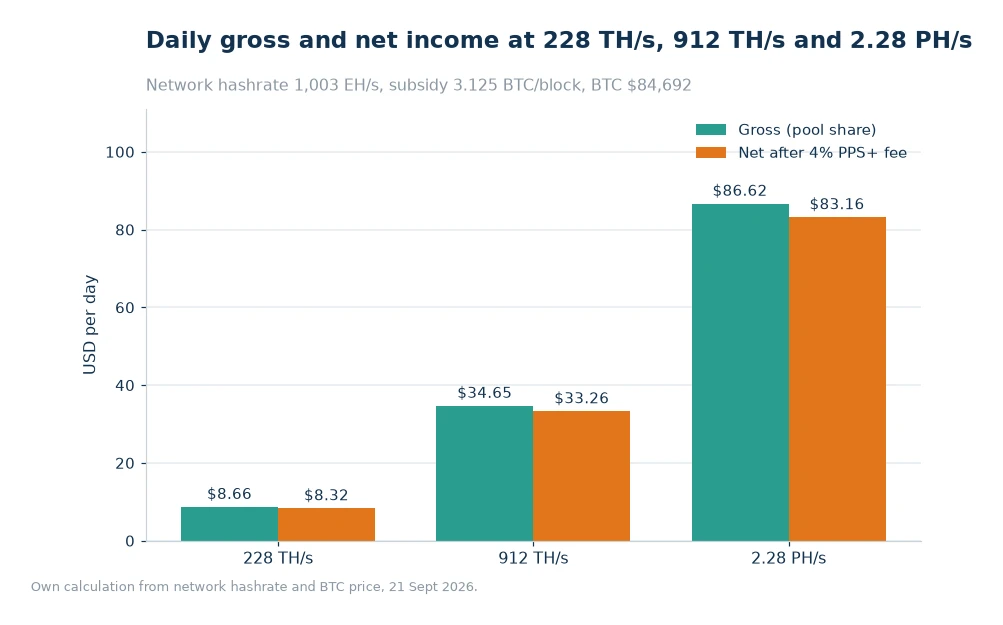
| Hashrate | BTC per day | Gross USD per day | Net USD per day |
|---|---|---|---|
| 228 TH/s | 0.00010228 | $8.66 | $8.32 |
| 912 TH/s | 0.00040917 | $34.65 | $33.26 |
| 2.28 PH/s | 0.00102282 | $86.62 | $83.16 |
Read the middle row as a sanity check on any sales page: 912 TH/s, four times the small rig, returns exactly four times the coins and four times the dollars. There is no volume discount in the schedule and no penalty for being small. The only real difference between the rows is how much absolute money is at stake when the price of Bitcoin moves.
Worked example
Take the three hashrate bands in the chart and push them through the same formula, with chain inputs read on 21 Sept 2026.
- Daily output per terahash is 450 BTC divided by 1,003,000,000 TH/s, which is 0.00000044865 BTC.
- At 228 TH/s: 228 × 0.00000044865 = 0.00010228 BTC. At $84,692 that is $8.66 gross.
- The listed 4% applies to the block-reward component: 4% of $8.66 is $0.35, leaving $8.32 net.
- At 912 TH/s: 912 × 0.00000044865 = 0.00040917 BTC, worth $34.65, less 4% of $34.65, or $1.39, for $33.26.
- At 2.28 PH/s: 2,280 TH/s × 0.00000044865 = 0.00102282 BTC, worth $86.62, less $3.46, for $83.16.
- Across 30 days at 228 TH/s the gross total is 0.0030684 BTC, or $259.85, of which the listed 4% takes $10.39 and leaves $249.46.
What sits beyond Bitcoin
The pool carries 20+ coins, among them BCH, LTC and DOGE through merged mining, plus KAS, ZEC, HNS, CKB and ETC. Merged mining is the one to understand if you run Scrypt hardware: the same work secures more than one chain, and the payout report lists the merged output separately. The Profit Calculator includes merged output when it estimates a day's return, so the estimate matches the statement rather than half of it.
Two smaller pieces complete the picture. The ViaBTC App for iOS and Android mirrors the dashboard and sends hashrate alerts, which is how most operators catch a dead board before it costs a full day of output. Mining Farms lists hosting options for hardware you would rather not run at home. Neither changes the formula in the worked example, but both change how often you have to sit in front of a screen to confirm the formula is still working.
Frequently asked questions
Is 228 TH/s enough to earn a daily payout?
Yes. At 1,003 EH/s of network hashrate, 228 TH/s produces 0.00010228 BTC a day, and PPS+ settles that hourly against current difficulty, so the balance moves in small steps rather than waiting for a block.
Why is the net figure not 4% below the gross figure?
Because the listed 4% applies to the block-reward component, not to the whole payout; the transaction-fee portion follows a separate listed 2% under PPS+, and fees are a small part of the total on most days.
Does a bigger hashrate get a cheaper rate?
No. The published rates do not step down with size, so 2.28 PH/s pays ten times the dollars of 228 TH/s for the same listed percentage; scale changes the amount, never the rate.
Put the four numbers on one line
Write down your share of the network, the BTC it produces per day, the gross dollar value and the net after the listed rate. Do it once, then again after the next difficulty adjustment, which was estimated at −2.12%. Any product you are offered can be judged against those four numbers in under a minute. If a pitch quotes a percentage without naming the component it applies to, the pitch is incomplete, and the arithmetic above is the fastest way to say so.
Sources: the ViaBTC pool pages for product names and the fee schedule that sets the listed 4% and 2% rates[1], plus chain figures read 21 Sept 2026 — network hashrate 1,003 EH/s, difficulty 132.76 T, subsidy 3.125 BTC per block, 144 blocks a day and BTC $84,692 — published 22 Oct 2026. Every dollar figure is arithmetic on those inputs and moves when they move.